
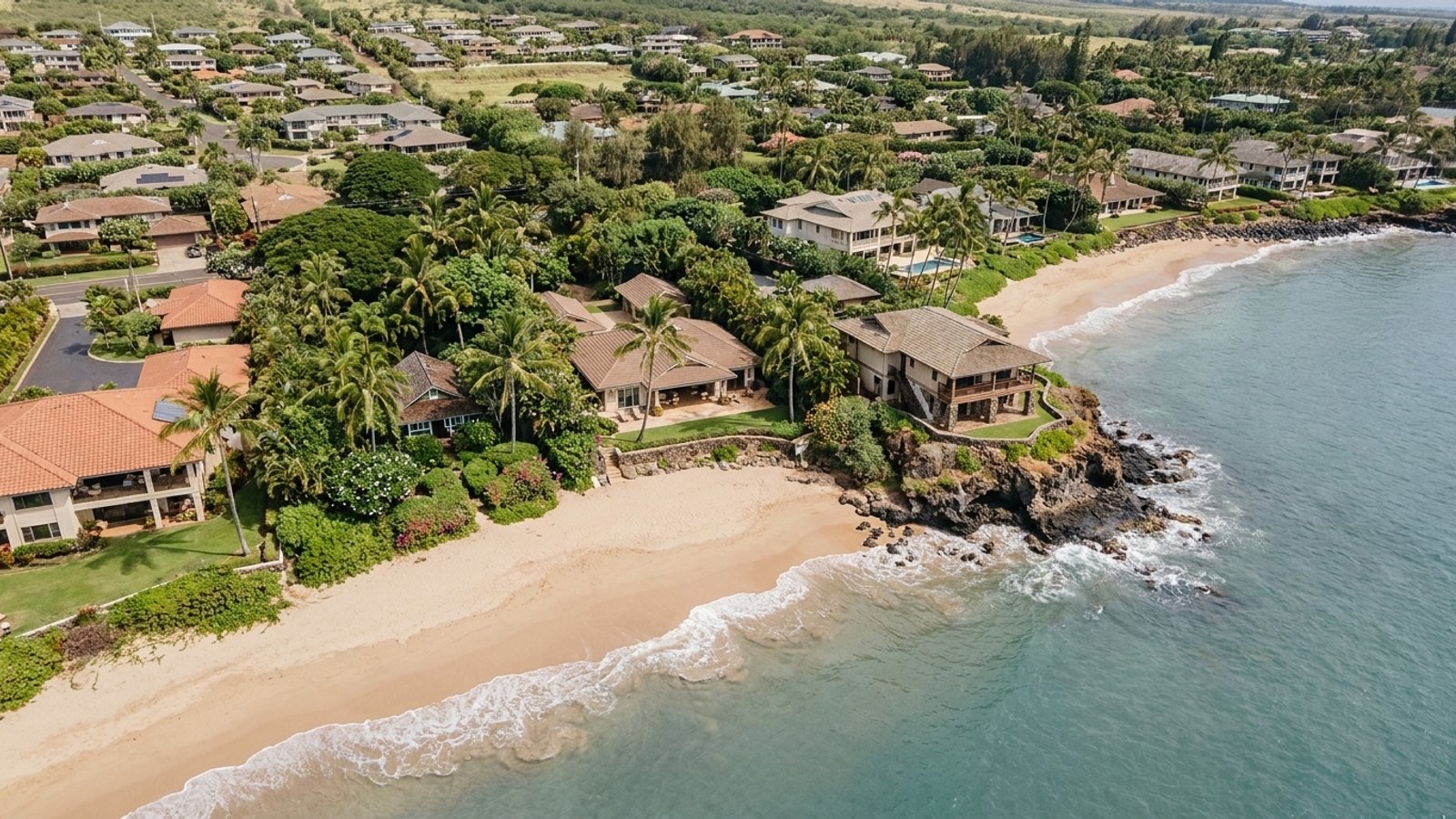
Oceanfront property values in Maui are shaped by far more than square footage or a recent nearby sale. In the luxury market, buyers weigh location, beach access, privacy, condition, zoning, rental flexibility, and long-term ownership confidence before they decide what a property is truly worth.
If you own a high-value coastal asset, the goal is not to guess. The goal is to understand your market position, protect your equity, and build a pricing strategy that reflects how qualified buyers think today.
TL;DR
- Oceanfront property values Maui vary widely by submarket, property type, beach usability, privacy, and condition.
- Two homes with similar interior size can have very different values if one has sandy beach frontage, stronger view protection, or better renovation quality.
- Recent comparable sales matter, but they are only part of the valuation process.
- Active and pending competition often tells you more about current buyer behavior than older sold data alone.
- Oceanfront condos, single-family homes, and redevelopment parcels should never be valued the same way.
- Price per square foot is a weak primary tool for valuing Maui luxury oceanfront real estate.
- The smartest way to estimate value is to build a pricing range, not rely on one fixed number.
- Seller goals matter. A strategy for maximizing price is different from a strategy for speed, privacy, or tax timing.
- A custom valuation is essential when the property has unique frontage, zoning, rental rights, or coastal risk factors.
What Are Oceanfront Property Values in Maui?
Oceanfront property value in Maui is the market-supported price a buyer is willing to pay for direct coastal ownership, adjusted for location, view quality, beach access, property condition, zoning, privacy, risk, and current luxury buyer demand.
That matters because not all oceanfront properties are valued the same. A beachfront condo in Wailea, an estate in Makena, and a bluff-front home on the North Shore may all be oceanfront, but buyers value them through very different lenses.
What Determines Oceanfront Property Values in Maui?
Oceanfront property values in Maui are influenced by a combination of lifestyle appeal, financial logic, and risk perception. Buyers are not just paying for proximity to the water. They are paying for confidence.
The biggest value drivers include:
- Location and neighborhood prestige
- Direct beach frontage versus bluff-front or rocky shoreline
- Beach access and swimmability
- Quality of ocean views and sunset orientation
- Lot size and usable outdoor living space
- Home size, layout, and architectural quality
- Renovation level and maintenance history
- Privacy and security
- Zoning and rental potential
- HOA fees, rules, and reserve strength for condos
- Coastal erosion, flood zone, and insurance considerations
- Current inventory and recent comparable sales
- Buyer demand in that specific price tier
A luxury buyer will often pay a premium when a property feels easy to own, easy to enjoy, and low in uncertainty.
Why Oceanfront Pricing in Maui Is Different From Standard Valuation
Oceanfront homes are not commodities. Each parcel has a different shoreline experience, orientation, setback profile, privacy level, and view plane.
That is why broad averages can mislead owners. In Maui luxury markets, scarcity matters, but scarcity alone does not guarantee top-dollar value. Scarcity has to be paired with desirability, usability, and buyer confidence.
Why Price Per Square Foot Can Be Misleading
Price per square foot works best when properties are similar enough to compare directly. Oceanfront real estate rarely fits that standard.
A home with smaller interior space but direct sandy beach access, protected views, and strong privacy may command far more than a larger house with rocky frontage or deferred maintenance. Buyers often place a premium on the experience of the land and shoreline, not just the size of the structure.
Why Buyer Confidence Changes Value
Luxury buyers pay more when the property feels clear, stable, and well-documented. That includes:
- Strong maintenance records
- Permit and zoning clarity
- Better insurance visibility
- Lower perceived repair risk
- Rental flexibility where relevant
- Well-managed building operations for condos
- Long-term usability and ownership confidence
Most value loss does not happen because a property lacks appeal. It happens when the market perceives uncertainty, inconvenience, or pricing misalignment.
Maui’s Major Oceanfront Luxury Markets
Different Maui submarkets tell different value stories. That is one reason Maui oceanfront property values can vary so dramatically.
Wailea Oceanfront Property Values
Wailea buyers often pay for polish, convenience, and resort lifestyle. Oceanfront condos and residences here compete on prestige, walkability, amenities, and turnkey condition.
Value is often driven by:
- Access to Wailea beaches
- Gated or highly managed communities
- Renovation quality
- Amenity package
- Ocean view quality
- Rental potential where allowed
In Wailea, presentation matters. Buyers often pay more when the property feels elegant, effortless, and move-in ready.
Makena Oceanfront Property Values
Makena is often about privacy, rarity, and estate-style ownership. Inventory tends to be limited, and direct comparisons can be difficult.
Key value drivers include:
- Large lots
- Direct oceanfront positioning
- Architectural quality
- Separation from neighbors
- Protected views
- Scarcity
In Makena, buyers are often less focused on raw square footage and more focused on exclusivity and long-term lifestyle value.
Kapalua Oceanfront Property Values
Kapalua combines oceanfront appeal with golf, resort access, privacy, and a distinct West Maui identity. Buyers here often compare the market with other global resort destinations.
Value tends to rise with:
- Bluff-front or oceanfront position
- Sunset and outer-island views
- Gated privacy
- Resort access
- Outdoor living quality
- Condition and maintenance
Kapalua value is often the combination of oceanfront ownership and broader resort prestige.
Kaanapali Oceanfront Property Values
Kaanapali carries strong name recognition and vacation lifestyle appeal. Oceanfront condos here may attract second-home buyers, investors, and part-time users.
Important factors include:
- Direct beach access
- Building reputation
- Unit stack and floor level
- Rental history and zoning
- View corridor
- HOA strength and fees
- Turnkey condition
In Kaanapali, buyers often balance personal enjoyment with income potential and ownership confidence.
Kihei Oceanfront Property Values
Kihei covers a wider range of product types than many luxury owners expect. That means valuation depends heavily on context.
Major drivers include:
- South versus North Kihei positioning
- Rental eligibility
- Beach access
- Walkability
- Building quality
- Relative value compared with Wailea
- Condition and income potential
Kihei oceanfront values are often strongly influenced by zoning and flexibility, not just frontage alone.
Paia, Spreckelsville, and North Shore Oceanfront Values
North Shore buyers tend to have a more specific lifestyle profile. They may prioritize privacy, acreage, surf access, architectural individuality, and a less resort-oriented setting.
Value can hinge on:
- Lifestyle fit
- Wind and surf exposure
- Lot size
- Scarcity
- Privacy
- Build quality
- Flood and shoreline considerations
These properties can command a premium with the right buyer, but positioning has to be precise.
Oceanfront Condos vs. Oceanfront Homes
An oceanfront condo, estate, and vacant parcel may all be oceanfront, but buyers do not value them the same way.
Oceanfront Condos
Condo values are often shaped by:
- Building reputation
- Floor level and unit stack
- View corridor
- HOA fees and reserves
- Rental history
- Hotel zoning or vacation rental eligibility
- Amenity package
- Interior renovation and furnishings
Oceanfront Single-Family Homes
Single-family home values are more heavily influenced by:
- Land value
- Lot size
- Beach frontage quality
- Privacy
- Setbacks
- Architecture
- Outdoor living areas
- Permitting and improvements
- Maintenance burden
- Insurance and coastal exposure
Oceanfront Land or Redevelopment Opportunities
Vacant or redevelopment-oriented parcels require a different lens altogether. Buyers will focus on entitlement complexity, shoreline setbacks, infrastructure, permitting, and risk tolerance.
How to Estimate Oceanfront Property Values Maui in 6 Smarter Steps
The most reliable valuation process is strategic rather than reactive. Here is how I would estimate oceanfront property values Maui with more precision.
Step 1: Identify the True Property Category
Do this: Define the property correctly before comparing it to anything else.
Why it matters: A hotel-zoned oceanfront condo, beachfront estate, bluff-front residence, and redevelopment parcel attract different buyers and pricing logic.
How to do it:
- Identify whether it is a condo, single-family home, land parcel, or mixed-use opportunity
- Confirm whether it is direct beachfront, bluff-front, or simply near the shoreline
- Review zoning, rental rights, and ownership use cases
- Place it in the correct luxury submarket
Example: A remodeled oceanfront condo in Wailea should not be valued against a residential oceanfront home in Kihei, even if both have strong views.
Step 2: Review Recent Comparable Sales
Do this: Study the most relevant sold properties first.
Why it matters: Sold comps establish what buyers have actually paid, not what sellers hoped to get.
How to do it:
- Focus on the same neighborhood or micro-market
- Compare similar property type and price tier
- Match for frontage, view quality, and privacy where possible
- Adjust for condition, layout, and renovation level
- Note timing, because luxury markets can shift
Example: A recent sale with direct sandy access may justify a premium over a similar-sized property with rocky shoreline and less usable outdoor space.
Step 3: Evaluate Active and Pending Competition
Do this: Look at what qualified buyers can choose right now.
Why it matters: Buyers compare current options, not just closed sales. Active listings shape leverage. Pending sales reveal current momentum.
How to do it:
- Identify competing listings in the same segment
- Compare your property’s strengths and weaknesses
- Review days on market and pricing behavior
- Watch pending activity for signs of current demand
- Assess whether your property has a clear reason to be chosen
Example: If competing oceanfront homes offer stronger updates, better beach access, or lower ownership friction, your pricing strategy must reflect that.
Step 4: Adjust for Unique Oceanfront Features
Do this: Add or subtract value based on the property’s real-world differences.
Why it matters: Oceanfront value is often created by details broad data cannot capture.
How to do it:
- Evaluate beach quality and usability
- Measure view protection and sunset exposure
- Assess privacy from neighbors and public access
- Factor in outdoor living areas, pool, lanai, and landscaping
- Account for renovation quality and documentation
- Consider zoning, rental flexibility, and maintenance exposure
Example: Two oceanfront homes may look similar online, but the one with protected view corridors, stronger privacy, and turnkey systems may command a materially higher price.
Step 5: Consider Seller Goals
Do this: Align valuation with the outcome you actually want.
Why it matters: The best pricing strategy for maximum price is not always the best strategy for timing, discretion, or tax planning.
How to do it:
- Clarify whether your priority is price, speed, privacy, or certainty
- Consider exchange deadlines or estate planning
- Evaluate whether pre-listing updates are worthwhile
- Decide how much market testing risk you are willing to take
Example: A seller seeking a faster, more certain sale may choose a tighter pricing strategy than an owner willing to hold out for an aspirational premium.
Step 6: Build a Pricing Range, Not Just a Number
Do this: Create a realistic range of probable value instead of anchoring on one fixed figure.
Why it matters: Luxury oceanfront pricing is not exact. A range helps you understand buyer response scenarios and preserve leverage.
How to do it:
- Establish a conservative likely-sale floor
- Define a market-supported target range
- Identify the premium case if the property is uniquely positioned
- Match the list price to your strategy and competition
- Reassess quickly if early buyer feedback is weak
Example: A pricing range may show that one strategy maximizes attention and speed, while another aims for a narrower buyer pool at a higher number.
The Biggest Factors That Can Increase Value
Certain features consistently support stronger Maui beachfront property values.
- Direct, usable beach access
- Protected, unobstructed ocean views
- Turnkey condition
- Strong privacy
- Rental flexibility where relevant
- Complete documentation
- Scarcity within the immediate submarket
Luxury buyers often pay a premium for ease. If the property feels cared for, documented, and ready to enjoy, it tends to preserve leverage.
Factors That Can Reduce or Limit Value
Honest valuation requires looking at what may hold a property back.
- Deferred maintenance
- Outdated interiors
- Poor renovation choices
- High HOA dues without perceived value
- Weak rental story where income matters
- Limited beach usability
- Erosion or flood concerns
- Insurance difficulty
- Restrictive rules
- Poor presentation
- Unrealistic pricing
- Better competing listings
The market discounts uncertainty faster than many owners expect.
Common Mistakes Owners Make
Owners often make the same valuation errors, especially with unique coastal assets.
- Assuming all oceanfront properties appreciate the same way
- Using price per square foot as the main tool
- Ignoring active competition
- Overvaluing personal improvements
- Underestimating buyer concerns about risk
- Waiting too long to get a professional market opinion
- Relying on generic automated estimates
If you only avoid one mistake, avoid pricing based on emotion instead of market position.
What Oceanfront Sellers Should Do Before Listing
Before listing, reduce uncertainty wherever possible. That strengthens buyer confidence and helps preserve negotiating leverage.
Prepare:
- Maintenance records
- Improvement list
- Permit documentation
- HOA documents if applicable
- Rental records where relevant
- Insurance information
- Survey or site details
- A clear explanation of zoning and use
Presentation also matters. Clean windows, refreshed landscaping, strong lanai staging, and repaired visible wear can materially change perceived value in the luxury market.
FAQ
What affects oceanfront property values in Maui?
Oceanfront property values in Maui are influenced by location, beach access, view quality, condition, zoning, privacy, rental potential, coastal exposure, insurance considerations, and recent comparable sales. Luxury buyers also care about long-term ownership confidence and scarcity.
Are oceanfront homes in Maui worth more than ocean-view homes?
Usually yes, but not always by the same margin. Direct oceanfront ownership often commands a premium, though privacy, risk, condition, and beach usability can narrow or widen that gap.
How do I estimate the value of my Maui oceanfront property?
Start by identifying the true property type, reviewing recent sold comps, analyzing active and pending competition, adjusting for unique features, and building a pricing range. A custom valuation is far more reliable than an automated estimate.
Do oceanfront condos and homes appreciate differently?
Yes. Condos are influenced heavily by building reputation, HOA strength, amenities, and rental rules. Homes are more influenced by land value, frontage, privacy, architecture, and long-term maintenance exposure.
Should I renovate before selling?
Not always. Strategic repairs, cleaning, styling, and presentation updates often deliver better returns than major renovations. Every improvement should be weighed against buyer expectations in that specific submarket.
Why are automated estimates unreliable for Maui oceanfront homes?
Automated tools often miss beach quality, shoreline nuance, view protection, privacy, zoning, rental eligibility, and risk factors. Those details can create major value differences between properties that look similar on paper.
Final Thoughts
Oceanfront property values in Maui are driven by scarcity, confidence, and strategy. Not all oceanfront properties are valued the same, and the difference between a strong valuation and a weak one often comes down to how well the property is categorized, compared, positioned, and priced.
If you are thinking about selling, holding, renovating, or refinancing, start with a clear understanding of your current market position. That is how you avoid pricing misalignment, protect your equity, and make decisions from a position of strength.
If you own oceanfront property in Maui and want a clear view of its current market position, Romvari Realty can provide a private, property-specific valuation and selling strategy.