
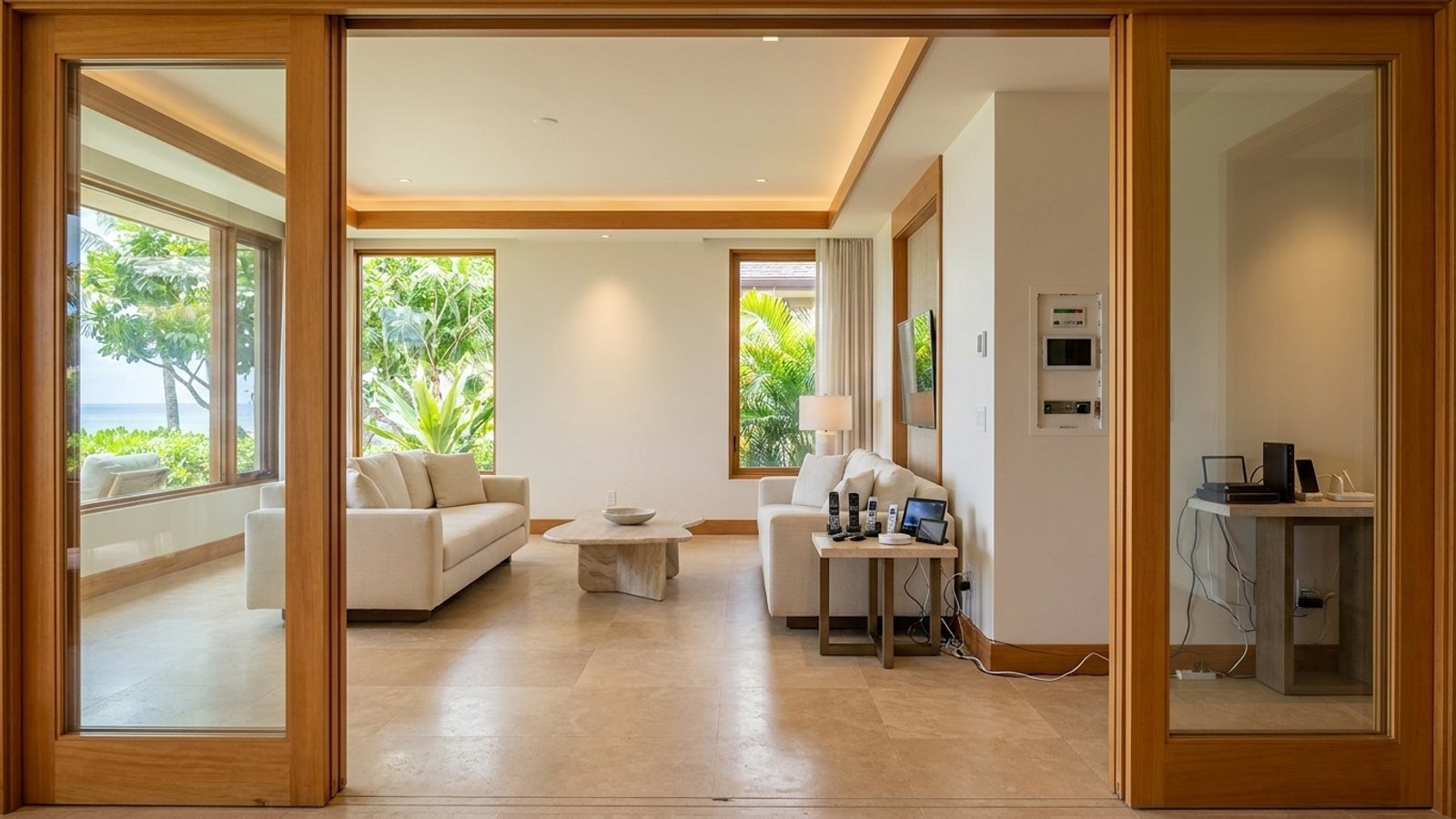
Expensive smart home features can make a luxury property feel current, effortless, and highly desirable. They can also create friction, confusion, and buyer hesitation if they are outdated, hard to use, poorly documented, or overly customized.
That is the real issue with luxury home technology innovations: they may support value, but they do not automatically raise a home’s sale price. The systems that matter most are the ones that improve comfort, security, resilience, remote ownership, and everyday ease without overwhelming the buyer.
Key takeaways
- Luxury home technology innovations add the most value when they make the property easier to own, easier to manage, and easier to trust.
- High-end buyers typically want seamless, discreet, and reliable systems, not complicated gadget collections.
- The most meaningful categories include whole-home automation, security, lighting, shades, climate control, energy management, leak detection, entertainment, wellness, and remote monitoring.
- In Maui, technology is especially relevant for off-island owners, second homes, oceanfront properties, resort residences, and large estates.
- Outdated, unsupported, intrusive, or undocumented systems can become buyer objections rather than selling points.
- Before listing, sellers often benefit more from servicing, simplifying, testing, and documenting existing systems than from installing expensive new ones.
- The best technology strategy is property-specific. A Wailea estate, Kihei condo, and Upcountry acreage home should not be approached the same way.
What are luxury home technology innovations?
Luxury home technology innovations are integrated systems and smart features that improve comfort, security, convenience, energy management, entertainment, wellness, and remote ownership in high-end properties.
What makes them valuable is not novelty. It is how well they support the ownership experience.
Why home technology matters in luxury real estate
Technology is now part of the luxury value proposition. Buyers at the high end often expect homes to feel refined, secure, intuitive, and ready for modern living.
The strongest systems work quietly in the background. They reduce friction instead of adding another layer of complexity.
Luxury buyers expect convenience without complexity
A premium system should feel effortless. If a buyer needs a tutorial just to adjust lights, unlock a gate, or control the shades, the technology starts to feel like a burden.
That is why simple interfaces, stable performance, and clear controls matter so much. In luxury real estate, sophistication should feel easy.
Technology can support the property’s value story
The right systems help reinforce a home’s positioning. They can support privacy, turnkey ownership, wellness, energy resilience, entertainment, and remote management.
For a second-home owner, a smart leak detector and remote climate alerts may matter more than a flashy voice assistant. For an oceanfront estate, corrosion-conscious outdoor systems and humidity monitoring may be far more persuasive than a media wall.
Technology should match the property
A luxury technology strategy should fit how the home lives.
- A Wailea or Makena estate may benefit from privacy systems, lighting scenes, shades, integrated outdoor audio, and wellness technology.
- A Kapalua or Kaanapali residence may need humidity control, remote monitoring, and HOA-compatible access systems.
- A Kihei oceanfront condo may benefit most from leak detection, smart locks, energy tracking, and low-maintenance controls.
- An Upcountry estate may place a higher premium on gate access, irrigation controls, backup power, strong Wi-Fi, and property-wide monitoring.
What high-end buyers expect from luxury home technology
High-end buyers usually care less about the word “smart” and more about the result.
They want technology that feels integrated, modern, secure, and professionally maintained.
Seamless integration
The best luxury smart home features connect major systems into one clear experience.
That may include:
- Lighting
- Climate
- Security
- Cameras
- Shades
- Audio and video
- Pool and spa controls
- Irrigation
- Energy monitoring
- Smart locks and gate access
If every feature requires a different app, remote, or workaround, the home feels patched together rather than thoughtfully designed.
Reliability and support
Smart homes are only as strong as their infrastructure. Strong Wi-Fi, clean network design, local service support, and transferable system knowledge are critical.
Buyers want confidence that the technology will still work after closing. They also want to know who can service it.
Discretion, privacy, and design alignment
The best high-end home technology blends into the architecture. Hidden speakers, clean keypads, discreet cameras, minimal visible wiring, and design-conscious hardware all help a property feel elevated.
Visible low-end devices can work against a luxury presentation. So can intrusive camera placement or unclear control over recordings and access.
The luxury home technology innovations that matter most
The most marketable systems tend to solve real ownership needs. Here are the categories that usually matter most.
Whole-home automation
Whole-home automation centralizes control. That can include lighting, climate, audio, video, security, shades, pool functions, and “away” or “guest” modes.
This category appeals to buyers because it reduces operating friction. It can also make entertaining easier and remote ownership more manageable.
What sellers should prepare:
- System brand and installer
- Manuals
- Warranty details
- Service contacts
- App access instructions
- Transfer process
- Subscription details
- Known limitations
Smart security, access control, and privacy technology
Security is one of the clearest reasons buyers value smart home technology in luxury homes.
Important features may include:
- Monitored alarm systems
- Smart cameras
- Gate access
- Video doorbells
- Smart locks
- Motion and glass-break sensors
- Remote arming
- Vendor or guest access codes
For Maui luxury properties, this matters even more for second homes, vacation residences, gated estates, and homes managed from off-island.
Security technology can build confidence, but only when it is presented clearly. Buyers want protection, not uncertainty over who controls cameras, data, codes, or entry points.
Smart lighting and motorized shades
Lighting is one of the most effective luxury upgrades because buyers immediately feel the difference. Well-designed scenes can elevate architecture, improve nighttime ambiance, enhance photography, and strengthen indoor-outdoor living.
Useful scene examples include:
- Arrival
- Sunset
- Entertaining
- Dinner
- Movie
- Night pathway
- Vacation mode
Motorized shades also support privacy, heat control, UV protection, and view management. In Maui, where sun exposure and view orientation matter, shades can be both a comfort feature and a practical asset.
Climate control, air quality, and comfort systems
Comfort systems are often undervalued in marketing and highly valued in ownership.
Smart climate technology may include:
- Zone-based temperature control
- Remote management
- Humidity monitoring
- Vacation mode
- Energy tracking
- HVAC alerts
Indoor air quality systems may include filtration, ventilation, moisture monitoring, and humidity control. In Maui, those details matter because of heat, salt air, humidity, and periods when the home may sit vacant.
Energy management, solar, battery storage, and EV charging
Energy technology is one of the most practical forms of future-ready luxury.
Systems may include:
- Solar monitoring
- Battery storage
- Smart electrical panels
- Load management
- Energy dashboards
- EV charging
These features can support resilience, reduce operating friction, and make a large home easier to manage. They are especially relevant in markets where backup power and energy independence matter.
Documentation is essential here. Buyers need to know whether a solar system is owned, financed, or leased, what the battery terms are, and how the system transfers.
Water, leak detection, pool, spa, and irrigation technology
This category is highly valuable because it reduces ownership anxiety.
Features may include:
- Leak detectors
- Automatic shutoff valves
- Moisture sensors
- Pool and spa automation
- Irrigation monitoring
- Weather-responsive watering
For luxury homes with high-end finishes, extended vacancy periods, large outdoor spaces, or oceanfront exposure, these systems can be more meaningful than trendier upgrades.
Entertainment and outdoor living technology
Luxury buyers often imagine lifestyle before they imagine specs. Integrated audio, outdoor speakers, media rooms, landscape lighting, outdoor TVs, weather-resistant screens, and connected pool controls can help the home feel like a retreat.
The key is reliability. A premium entertainment system that fails during a showing damages confidence fast.
Wellness technology
Wellness is becoming a more important part of luxury home technology innovations. That may include air purification, water filtration, circadian lighting, steam showers, saunas, cold plunge setups, smart fitness rooms, humidity control, and sleep-focused bedroom environments.
These features work best when they feel broadly appealing. Overpersonalized systems can limit buyer connection.
Why technology does not automatically increase property value
This is the part many sellers miss.
Technology may support value when it:
- Improves comfort
- Reduces maintenance anxiety
- Supports remote ownership
- Enhances security
- Lowers operating friction
- Makes entertaining easier
- Improves energy resilience
- Feels integrated and modern
- Supports the property’s luxury positioning
- Differentiates the home from similar listings
But technology may have limited impact if it is:
- Outdated
- Hard to use
- Poorly installed
- Unsupported
- Undocumented
- Visually intrusive
- Overly personalized
- Tied to seller-only accounts
- Expensive to maintain
- Inconsistent with buyer expectations in that price tier
The strongest rule is simple: technology adds the most value when it makes the home easier to own, easier to manage, and easier to trust.
Common technology mistakes in luxury properties
The most common mistakes are not about buying the wrong gadget. They are about creating buyer uncertainty.
1. Technology for technology’s sake
A feature should serve comfort, security, resilience, efficiency, or lifestyle. If it does not, it is usually just noise.
2. Overly complicated systems
If the controls are confusing, the buyer may assume future headaches.
3. Poor documentation
Missing manuals, unknown passwords, vague ownership terms, and no service records can create real due diligence problems.
4. Weak Wi-Fi and network infrastructure
Luxury home automation depends on the network behind it. Strong infrastructure is foundational.
5. Outdated controls and unsupported apps
Old touchscreens and obsolete components can make the entire home feel dated.
6. Too many disconnected devices
A luxury home should feel integrated, not improvised.
Should sellers upgrade technology before listing?
Sometimes yes. Often not in the way people assume.
Pre-sale upgrades may make sense if the current system is broken, visibly outdated, unreliable, or clearly below buyer expectations for the price point. But last-minute, expensive automation projects can easily overcomplicate the sale.
Lower-risk improvements before listing
These are often the smartest moves:
- Service existing systems
- Replace broken controls
- Improve Wi-Fi coverage
- Clean up visible wiring
- Add leak detection
- Update smart locks
- Test all major systems
- Organize manuals and warranties
- Simplify interfaces
- Document solar and battery performance
Higher-risk improvements
Use caution with:
- Full automation overhauls right before listing
- Highly customized systems
- DIY smart device collections
- Technology without local support
- Complicated features that delay market launch
A better question is this: Will this upgrade make the property easier to own, easier to market, or easier for a buyer to trust?
How to evaluate luxury home technology before selling
If I were reviewing a luxury property before listing, I would use this process.
Step 1: Identify every installed system
List security, lighting, shades, climate, audio, video, solar, battery, EV charging, leak detection, pool controls, irrigation, network infrastructure, and wellness features.
Step 2: Confirm functionality
Test each system in real conditions. Do not assume it works because it worked six months ago.
Step 3: Evaluate buyer relevance
Ask whether the likely buyer will view the system as a benefit or a complication.
Step 4: Gather documentation
Collect manuals, warranties, service records, installer contacts, account transfer steps, and subscription details.
Step 5: Simplify the experience
Remove confusion where possible. Update controls, label what matters, and make demonstrations easy.
Step 6: Connect technology to the value story
Position each feature around comfort, privacy, resilience, convenience, remote ownership, and lifestyle.
FAQ
Does smart home technology increase luxury property value?
Smart home technology may support value when it improves comfort, security, energy management, resilience, and buyer confidence. It does not automatically increase value simply because it was expensive to install.
What are the most important luxury home technology innovations?
The most important categories usually include whole-home automation, smart security, lighting scenes, motorized shades, climate control, air quality systems, solar and battery monitoring, EV charging, leak detection, entertainment systems, and remote property monitoring.
Why is home technology especially important for Maui luxury properties?
Many Maui luxury homes are second homes, seasonal residences, or off-island-owned properties. Technology can help with remote oversight, leak detection, climate management, access control, security, and energy resilience.
Should I install new smart home features before selling?
Sometimes, but not automatically. In many cases, servicing, simplifying, documenting, and testing existing systems creates more value than adding expensive new technology right before listing.
What documentation should sellers prepare?
Gather manuals, warranties, installer contacts, service records, account transfer instructions, subscription details, solar and battery information, HVAC records, smart lock details, and network information.
Final thoughts
The best luxury home technology innovations do not call attention to themselves. They make the property feel effortless, secure, comfortable, and well cared for.
That is why expensive technology alone does not guarantee a higher sale price. Buyers respond to systems that support confidence, reduce friction, and fit the way the property is meant to live.
If your luxury home includes automation, security, solar, battery backup, wellness systems, or remote monitoring, the smartest next step is to evaluate how those features will actually be perceived in your market. Smart investments beat flashy gadgets, and documented systems beat vague claims every time.